Know your tires before you buy them.
Nobody should have to guess at the tire counter. Five minutes here and you'll read sidewalls, spot trouble early, and know exactly what to ask for — and if you'd rather just hand us the keys, that works too.
Sidewall 101
How to read your tire size
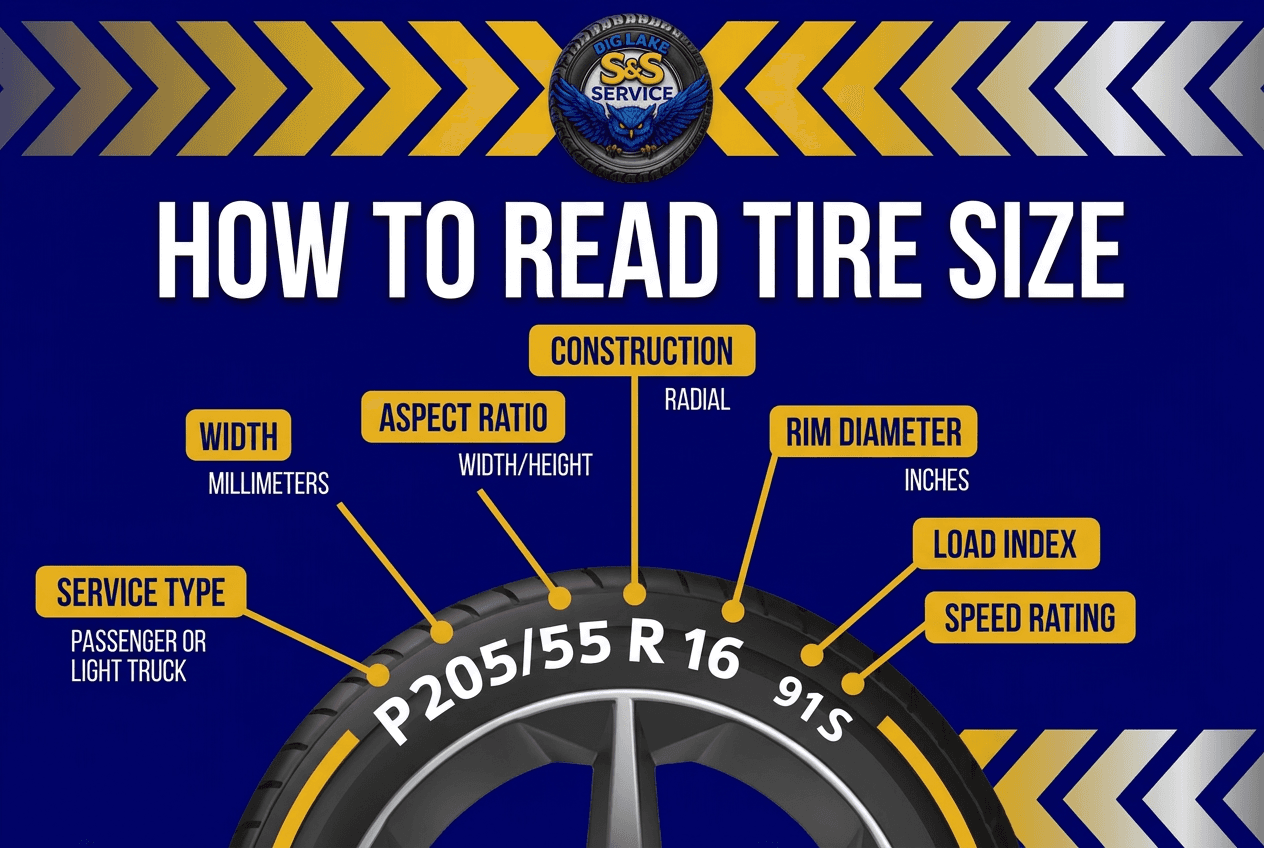
Every tire tells you exactly what it is — the code is stamped right on the sidewall. Take P205/55R16 91S: once you know what each part means, you can look up your own size in about ten seconds.
- P — Service type.
- P is passenger, LT is light truck. Heavier-duty tires carry LT for a reason — never downgrade a work truck to a passenger tire.
- 205 — Width.
- The tread width in millimeters, measured sidewall to sidewall.
- 55 — Aspect ratio.
- Sidewall height as a percentage of the width. Lower number = shorter, stiffer sidewall.
- R — Construction.
- Radial — how the internal plies are laid. Nearly every modern tire is a radial.
- 16 — Rim diameter.
- The wheel size it fits, in inches.
- 91S — Load index & speed rating.
- How much weight each tire can carry and the speed it is rated for. Matching these matters on loaded trucks.
Under the Rubber
What's inside a tire
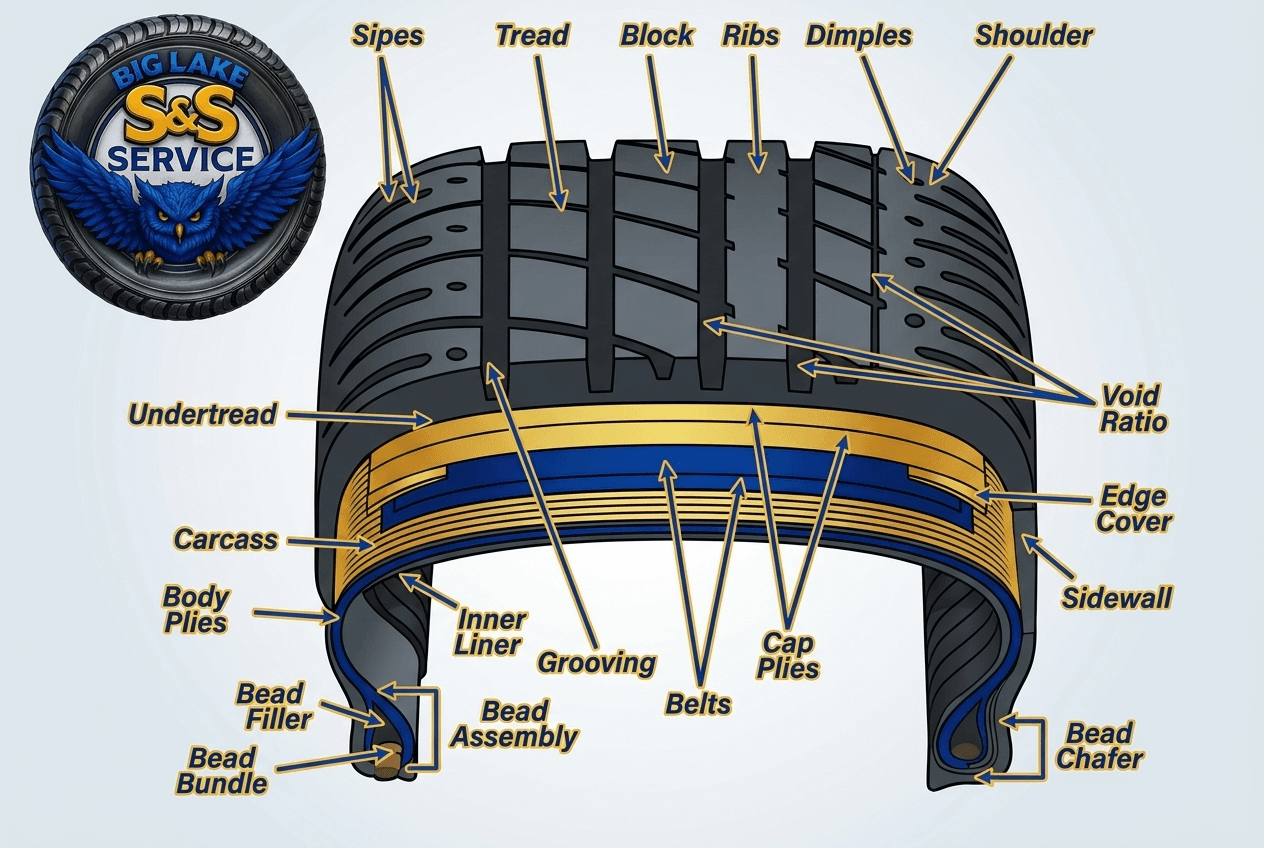
A tire isn't just rubber — it's steel belts, body plies, bead bundles, and an inner liner all working together. Knowing what's under the tread explains why some damage is repairable and some means replacement.
- Tread & undertread.
- The rubber that meets the road — where all your traction and wear life live.
- Steel belts & cap plies.
- The muscle of the tire. Damage here — like a belt separation — cannot be patched.
- Body plies & carcass.
- The skeleton that holds air pressure and carries the load.
- Bead assembly.
- The steel bundle that seals the tire to the wheel. A damaged bead means the tire will not hold air.
- Sidewall.
- Flexes millions of times per trip — which is why sidewall punctures are never safe to plug.
This is why we patch tires from the inside instead of stringing a plug through the belts — it protects the structure and keeps the repair safe at highway speed.
Grip, Explained
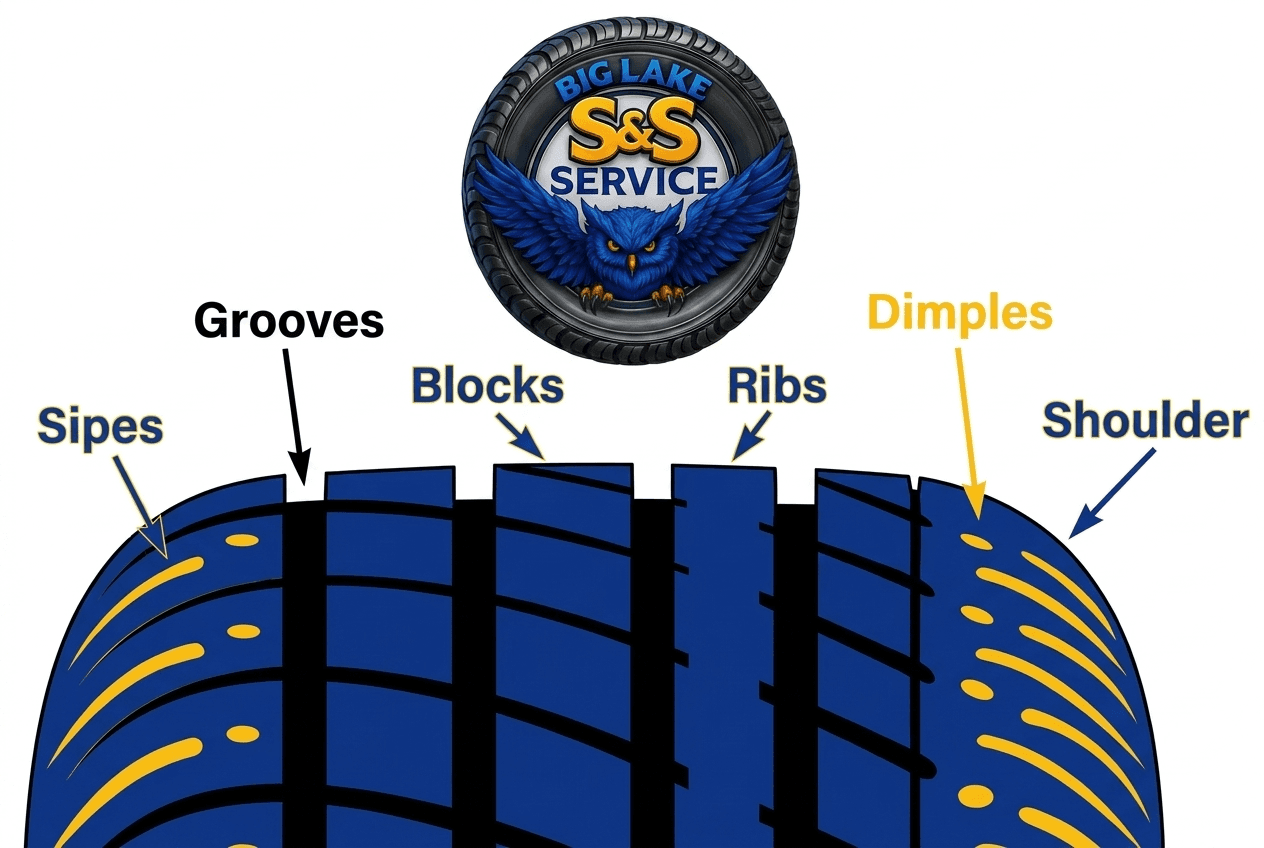
The tread, up close
All those blocks, grooves, and little slits are engineered — each one has a job, from biting into caliche to pushing water out from under the tire on a wet US-67.
- Grooves.
- The deep channels that evacuate water so you keep contact with the pavement instead of hydroplaning.
- Blocks & ribs.
- The big pads that grip and carry the load. Aggressive blocks = off-road bite; solid ribs = quiet highway stability.
- Sipes.
- Thin slits that open as the tire flexes, adding hundreds of extra gripping edges in wet or loose conditions.
- Dimples & shoulder.
- Cooling features and the transition to the sidewall — the shoulder takes the abuse in corners and on lease-road edges.
Read Your Tires
What your wear pattern is telling you
Tires never lie. The way they wear points straight at the problem — pressure, alignment, or suspension. Here's how to read the story before it costs you a new set.
- Toe wear.
- One edge wearing faster — usually a wheel alignment issue.
- Camber wear.
- Inner or outer side worn down — alignment, suspension condition, or hard cornering.
- Center wear.
- Middle wearing faster than the edges — the tire is overinflated.
- Edge wear.
- Both edges wearing faster — underinflated and running hot.
- Patch wear.
- Uneven patches — braking issues, suspension problems, or flat-spotting.
- Cup wear.
- Scalloped dips along the tread — usually worn shocks, struts, or suspension components.
We eyeball your tires with every oil change and tell you straight what they need — and a timeline, not a scare tactic.
Seeing one of these? Book a tire check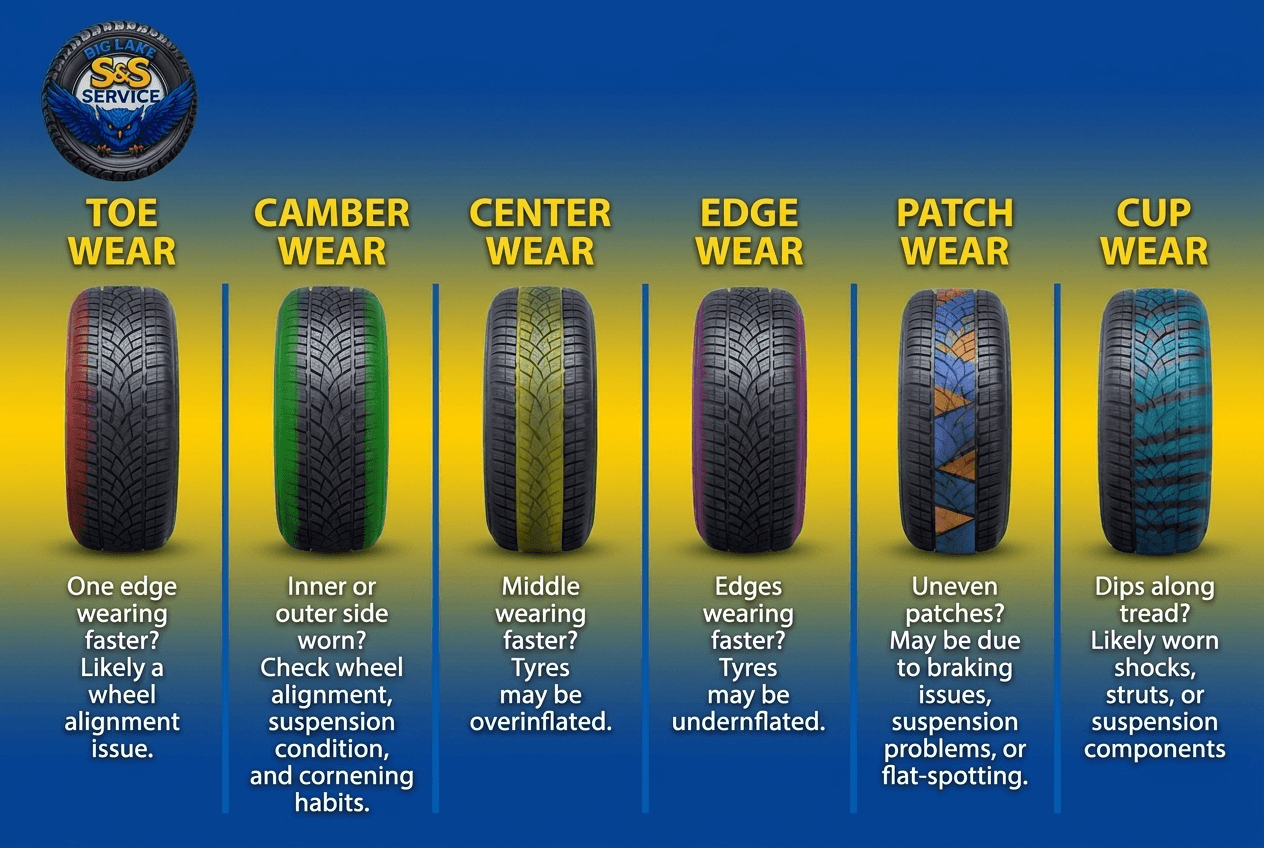
The Right Tool
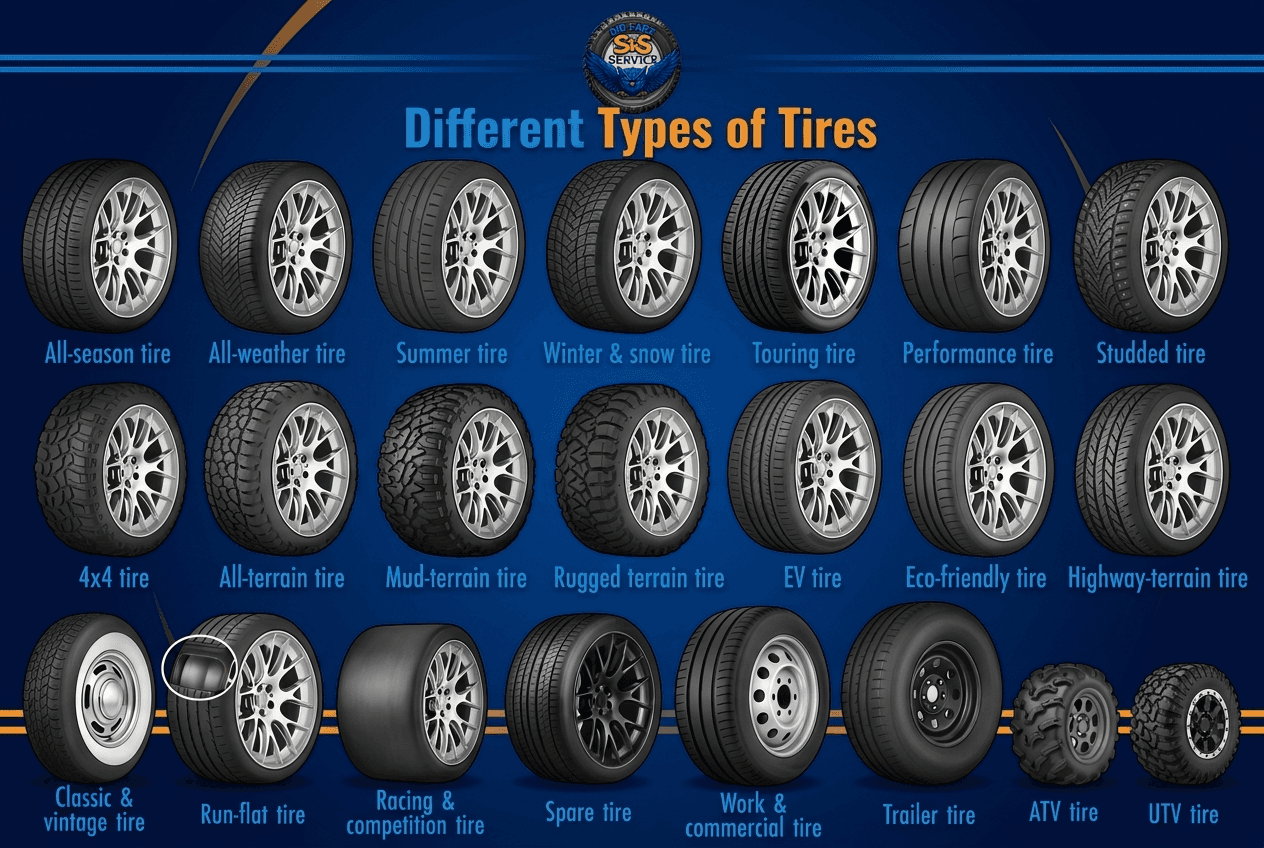
Different types of tires
From all-season commuters to mud-terrains and commercial rubber, every tire type is a different trade-off between grip, wear life, noise, and toughness. Out here the right answer is usually simple — and we'll tell you honestly which one your driving actually needs.
- All-season & touring.
- The daily-driver sweet spot — quiet, long-wearing, good in most West Texas weather.
- Highway-terrain (H/T).
- Built for trucks that live on pavement — smooth, stable, high-mileage.
- All-terrain (A/T).
- The Permian favorite. Pavement manners with enough bite for lease roads and ranch gates.
- Mud & rugged terrain (M/T, R/T).
- Maximum bite off-road — expect more noise and faster wear on the highway.
- Work & commercial.
- 10-ply and up, 11R22.5/11R24.5 — load range matters more than anything else here.
- Specialty.
- Trailer, ATV/UTV, ag and equipment tires — we source them all off the daily truck.